
In this article I want to ponder the meaning of “dead” as it is used in a number of Bible passages. To be fair, the phrase “spiritually dead” is never used, but clearly the references are not physical death. It is something else. I will also say as a preface that some of the things I will say are strictly theoretical. We are not given the answers. Nonetheless, I think it is intriguing food for thought.
Here is an example of the use of “dead” that I am talking about:
And you were dead in the trespasses and sins. (Ephesians 2:1) (ESV)
First, “dead” doesn’t mean non-existent. There is a cultural, faithless understanding that at physical death we cease to exist. Rubbish. Or maybe, “you wish”. Physical death only moves you and terminates your body. The Bible ultimately uses “death” to describe being forsaken by God in Hell. Maybe the passage above is just speaking of a legal status that will culminate in being forsaken in Hell. It is almost like the threat, “You’re a dead man.” I think that is part of it, but I suspect that there is more.
The Bible makes it clear that every human being has something wrong with them so that they do not “accept” the things of God. We are all “dead” naturally, even though we are physically alive.
14 The natural person does not accept the things of the Spirit of God, for they are folly to him, and he is not able to understand them because they are spiritually discerned.
1 Corinthians 2:14 (ESV)
“Natural” is this context is not talking about how we were created. It is talking about how we are born. There is a big difference. We know from our scientific inquiry that “natural” is usually the result of inherited DNA. This tracks. We inherited an altered set of DNA that has flaws introduced all the way back to our common parents: Adam and Eve. Now sinful human nature is a thing. What could Adam and Eve do before their corruption that we cannot? They could discern and accept the things of the Spirit of God. DNA, to my knowledge, only configures our physical bodies. It does not configure our spirit. Is there something about our bodies that makes us “dead” and unable to discern and accept the things of God?
This inquiry could get us a step closer to what Paul calls “the mystery of faith” or what modern theologians call, “the theologian’s cross”. These terms refer to the unanswered question about why some people can be brought to faith and salvation and others cannot. Answers like “choice” or “free will” don’t seem to cut it. Paul seems stumped and frustrated by the same thing.
Is the damage done by inheriting sinful nature more permanent in some people than others? We tend to want to make being damnable strictly a matter of human choice. I have no doubt that human choice is somehow involved. By why can you choose to reject God and not choose to believe Him? Why is 1 Corinthians 2:14 a true statement? Does choice prevent God from “fixing” something physical about us? If God would simply overpower us and fix our problem, would that somehow violate our integrity as a being with a will? These are questions I have that do not have detailed Biblical answers.
Is there anything in more recent science that might help with this inquiry? I do not believe that science and theology do not intersect. There are things that only revelation will tell us, and there are things that we can discover on our own. They come in contact. “Sinful nature” would be this vague concept that we could only experience the results without scientific inquiry. Understanding DNA makes a lot of theological pieces and verses come together. So what about this? There is an intriguing candidate.
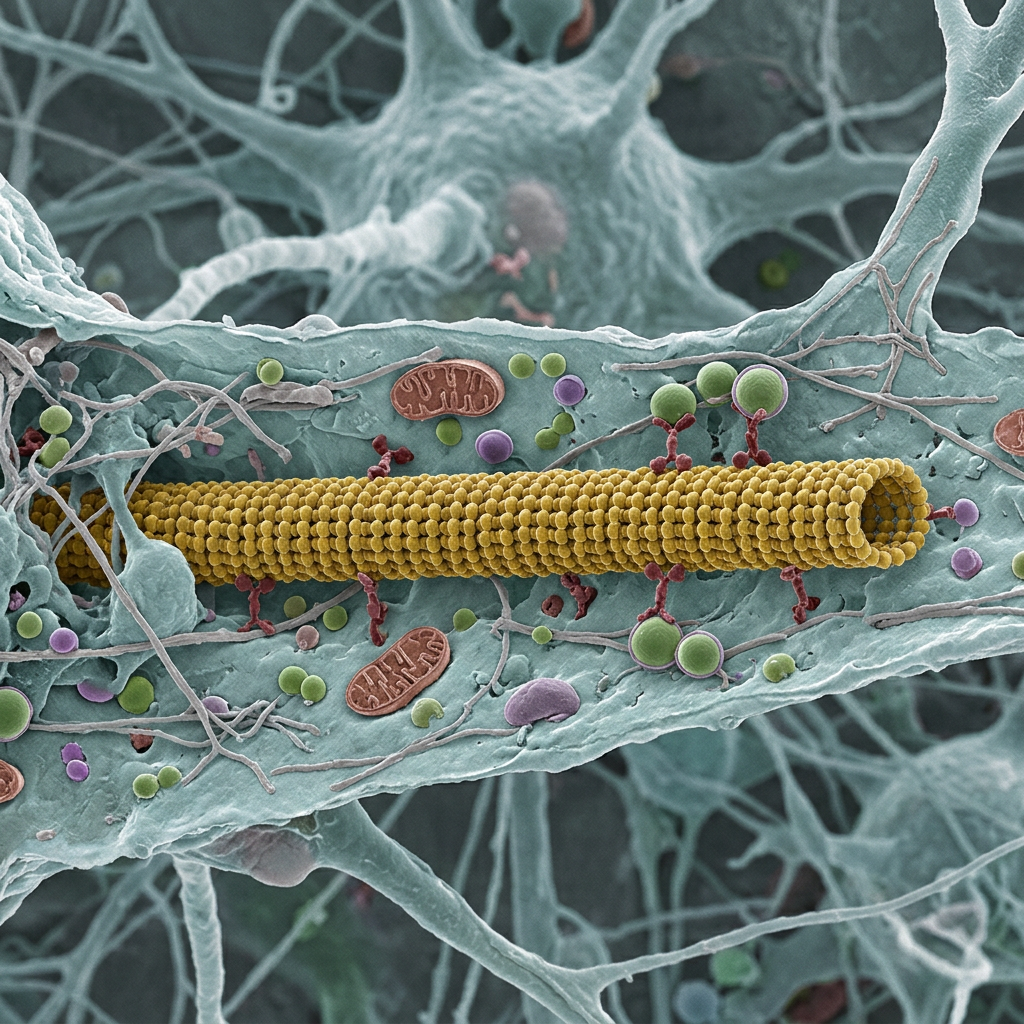
Recently, scientists have found on our neurons (brain cells) somethings that they are calling “mircotubules”. It is felt that these structures resonate with disturbances in “quantum fields”. I will be first to tell you that this is now out of my realm of understanding. So the rest of this is wildly speculative. The Bible describes our being as a body and a spirit, or body, soul and spirit. Our spirit seems to be a transferable, movable part of us that can be paired with a heavenly body (2 Corinthians 5:1), or a resurrected body (1 Corinthians 15), or possibly a body that would be resident in Sheol or even Gehenna (Hell). “Soul” is ill-defined, but could be a reference to the manifested interface of body and spirit. How do they interface? Could it be via microtubules? Could undamaged microtubules even be the way we were to interface with God and discern and accept the things of God?
Here is the theoretical narrative I am spinning that pulls from both the Bible, science, and our less than ideal experience. God created the original human beings with brains that successfully bound body and spirit via microtubules. These also allowed us to perceive the presence of God flawlessly, to communicate with Him direct to the brain, and to do it all without internal interference from any other source (i.e Satan). We were “tuned” to God. Satan pulled an external alteration by attacking our DNA via the “Tree of the Knowledge of Good and Evil”. These alterations made it inevitable that our bodies would wind down and die, they created brain structures that suggested, craved and rewarded what God considers evil, they damaged the microtubules so that they resonated with Satan rather than God. In some situations, these alterations allow external beings like Satan or demons to partially or fully displace the connection of our body and our spirit (possessed). A full or partial fix of the tubule damage allows God to guide us again via the Holy Spirit. The phrase “the Spirit dwells in us” means that God’s Spirit again controls the microtubules and Satan does not. It is the way we are bound together in the Body of Christ.
Another interesting possibility is that the genetic alteration caused by Satan phased in. When God altered us again to dial our potential lifespan back to 120 years (Genesis 6) that change took a couple generations to lock in. Does a “phase in” explain why God’s perceived presence eventually disappeared. Adam and Eve “saw” God even after their sin. Cain and Abel did too. Eventually that isn’t true except for rare and extraordinary circumstances. Human behavior continued to make a steep decline until a flood was in order.
Back to the original question. Does “dead in your sin” mean both a legal sentence (you are currently damned) and a physical situation (Satan has you by the tubules)? It could be. Many Bible believing people are uncomfortable with science. Many science people regard the Bible as myth. I get that. I carefully look at both. Maybe this is nothing. But maybe it explains a lot.


