
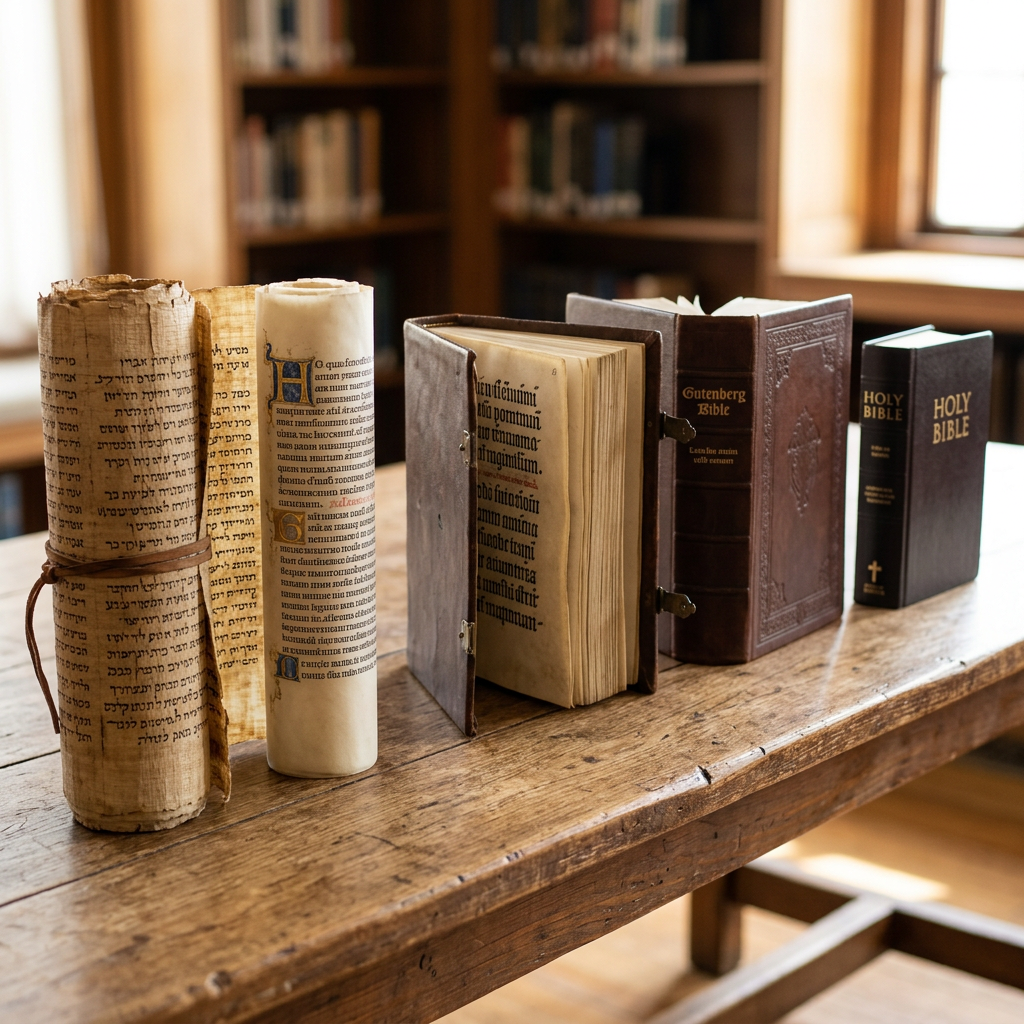
The Bible has been so influential in human history that reading even portions of it would beneficial to somebody’s general education even if they don’t regard it as inspired by God. I obviously have a bias. I do think that not only is it inspired by God, but that God actively uses it to communicate to us. It is not just a book about a religion. I would like to share with you how we have it in our own language (if you have it) and why it is reliable. I will also share some suggestions for getting started.
The Bible is not a book, it is sixty-six books written over a period of almost 1600 years with the last book written over 1900 years ago. As such, I would not blame you for questioning its relevance or the reliability of the transmission of the text over such an expanse of time. Most of that time copies were only made by hand, not printed or photocopied. Can we trust it?
Let’s start with the copying process. The scribes who made hand-written copies were humans. They made copying errors occasionally. To minimize those errors they utilized elaborate systems of counting letters to sniff out mistakes. If the number was off, they had to re-check their copy. It is like reconciling your bank balance perfectly. They still managed to make mistakes. These have been identified by modern scholars by comparing ancient texts and remnant of texts. Minor errors allow modern investigators to figure out what was copied from what all the back to nearly the original. This helps us know what the original said with a high degree of certainty. Portions of the Bible that still have some degree of uncertainty associated with them are usually denoted as such in the text. The biggest example is the end of the Gospel of Mark. Many of the earliest copies do not have anything after Mark 16:8. While Bible’s usually include Mark 16:9-20, it may not be original. I wouldn’t base a doctrine strictly on this section.
Transmission is one thing, translation is another. Unless you can read Biblical Hebrew or Greek, you will be reading how a group of scholars decided was the best way to express the concept of the original sentence in English or whatever language you are using. If you are multi-lingual or at least started to learn a second language, you realize that there may be several ways to express the same thing. That is why there can be many different translations. Most Bible translations try to stick as closely as possible to the sentence structure as well. Paraphrases, like The Message in English, are more free in their departure from the original sentence structure.
Can a Bible translation have a subtle denominational bias to it? Yes, it can. Sometimes not so subtle. There are some translations I would never use for that reason. Don’t let that deter you. King James, which is the oldest translation still in regular use in English, has a problem in that it was translated from a less reliable original text. Modern access to more ancient remnants has actually improved the reliability. I prefer the English Standard Version (ESV). It seems to be a solid translation of the original and reads well in English.
Let’s talk about relevance. If the Bible is just a compilation of ancient ideas about God and morality, then I am not interested in it either. If the Bible transmits stories about how the Creator of the universe interacted with people in past, information that God wanted passed through the ages, teaching that reflects the unchanging desires of God, God’s plan to bless my life and make my life eternally relevant, and God’s plan to give me eternal life, then that is important–extremely relevant. I believe it does that. My belief is largely connected to my experience with the Bible, but if I take a step back and look more critically at the Bible, I still find it believable because I think we can establish the historical truth of Jesus. He gives approval to the Old Testament by referring to it. The Old Testament in turn prophesies extensively about Jesus.
So where do you start if you have never read it? You don’t read it like a novel by starting at the first page and working to the end. The first 39 books are known as the Old Testament and were written before the time of Jesus. They are originally in Hebrew. The other 27 books were written shortly after Jesus and were in Greek. The whole of the Bible is not strictly chronological. It is more organized by literary genre. There are several genres including narratives (stories), teaching letters, prophecy, laws, poetry, wise sayings, even a census. Not every line in the Bible applies to you. The laws found in Leviticus were for ancient Israel, not you. There is nothing for you to gain from an ancient census. Many of the prophecies were about ancient kingdoms and do not have some allegorical application to you.
I would recommend that you start with one of Gospels. Matthew, Mark, Luke and John are the story of Jesus with the teaching of Jesus interspersed in them. After that you could continue with Acts, which is an account of the first century church, or jump to a teaching letter like Romans. The teaching expounds on the importance of Jesus and what God is looking for as a response to His actions and promises. I start you with Jesus because the most important aspect of the Old Testament is that it foretells of a coming chosen, important person (the Messiah), whose primary role is to deal with the sins of mankind and provide a way of having eternal life with God.
Maybe it seems strange to you that the Bible, which is claimed to be God’s Word, isn’t a monologue in which God alone speaks. The Quran is written that way. The Bible is a collection of books of various genres through which God continues to speak. Give Him a chance to speak to you.


