
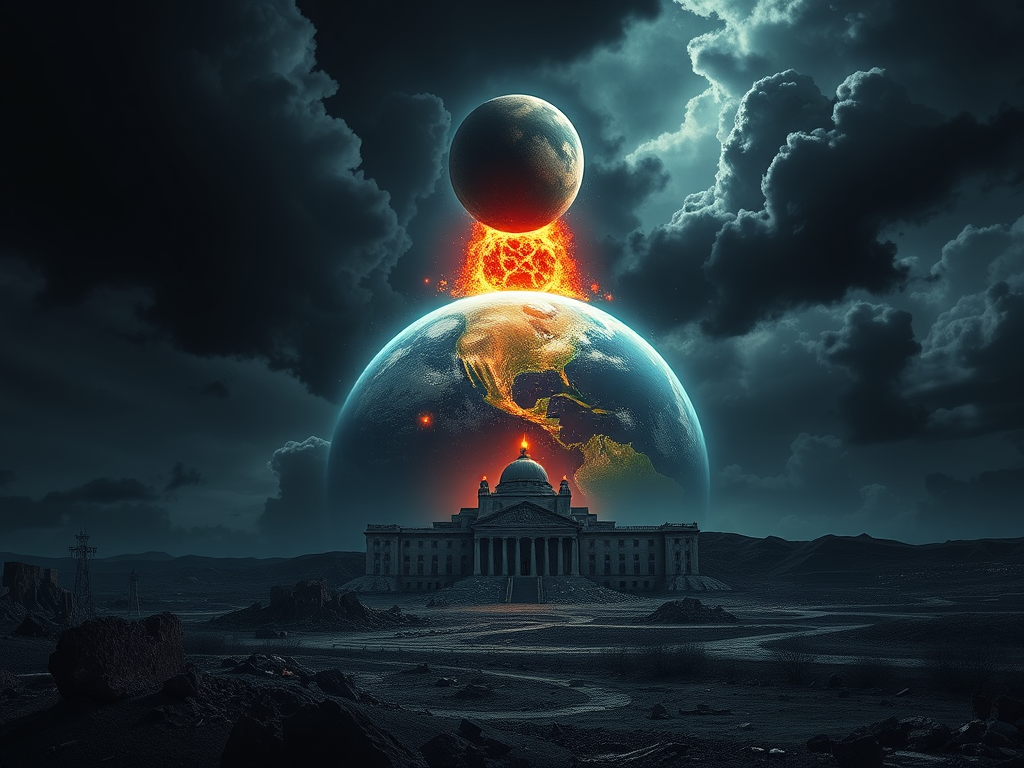
If you sat down and listed all the threats on the existence of mankind that you have heard, seen dramatized in a movie, or read about lately, how many could you come up with? Here is my list: nuclear war, global warming (threatening food production and global security), pandemic (man-made and natural), pandemic (released from the permafrost), asteroid strike, super-volcano, water shortage, energy shortage, cyber-terrorism destabilizing the economic system, soil loss, and some I probably forgot. Are these real concerns? I would say “yes”. Are they the wrath of God? I would say, “maybe”.
The bulk of the list above would fall under the category of “the Curse”. The Curse is how God warned Adam and Eve that the world would work now that they had rejected God. Nature just won’t cooperate. Is the Curse a form of the wrath of God? You could say so. God can and does intervene at times from letting the Curse be the Curse, but in general humanity is meant to have to deal with it. The curse will not exterminate mankind, but it can make things difficult.
How about nuclear war? This would be the result of man’s sin. It could also be the result of Satan urging leaders to sin.
At one point during the old cold war people read nuclear war into this passage:
7 But by the same word the heavens and earth that now exist are stored up for fire, being kept until the day of judgment and destruction of the ungodly.
2 Peter 3:7 (ESV)
This “fire” is clearly God eliminating the whole of universe at Judgment Day and not a reference to nuclear war. Does that mean that nuclear war is out of the question or not the wrath of God? It could possibly be part of this passage of Revelation often referred to as the Four Horsemen of the Apocalypse:
4 And out came another horse, bright red. Its rider was permitted to take peace from the earth, so that people should slay one another, and he was given a great sword.
Revelation 6:4 (ESV)
It is clear from Revelation that despite God’s desire to save, His compassion on mankind, and His patience, that humanity can wear down God’s tolerance and bring a “Day of the Lord” on themselves. The phrase “Day of the Lord” is used throughout the Bible to speak of a distinct time of judgment. It is not necessarily a reference to the final judgment day–more about that a little later.
The asteroid strike is a scary one. Not only does the government take that seriously, but it seems to be described in Revelation 8:
8 The second angel blew his trumpet, and something like a great mountain, burning with fire, was thrown into the sea, and a third of the sea became blood. 9 A third of the living creatures in the sea died, and a third of the ships were destroyed.
10 The third angel blew his trumpet, and a great star fell from heaven, blazing like a torch, and it fell on a third of the rivers and on the springs of water. 11 The name of the star is Wormwood. A third of the waters became wormwood, and many people died from the water, because it had been made bitter.
Revelation 8:8-11 (ESV)
Massive, life-altering asteroid hits are thought to be a part of the Earth’s past. Could they be a part of the Earth’s near future and not be just chance but rather the wrath of God? I think so. A big question for me about the curses in Revelation is are these a vision of things that will be or only things that might be? The nature of apocalyptic literature makes it hard to pin down with certainty. Either way it is something to respect.
An important insight into the judgment of God is found in John 12 as Jesus speaks about His upcoming crucifixion:
31 Now is the judgment of this world; now will the ruler of this world be cast out.
John 12:31 (ESV)
When Jesus is forsaken on the cross, we can see two things: the seriousness of sin to God and God’s way of lifting the required judgment off of those who are saved and on to His own Son. People will face God’s judgment on their lives as individuals at two points: their death and Judgment Day. Regardless of how good or evil they have been everyone falls short of God’s standard for self-righteousness. We all need Jesus. We all need our judgment to have already fallen on Him. Nominally, people will be damned because of their sinfulness; but functionally it will be based on whether they received forgiveness through the death of Jesus. In that sense, the whole judgment of the world happened when Jesus was crucified and forsaken.
It is possible, whether you belong to Christ or not, that you may have to live through a “minor” day of the Lord where disaster befalls the Earth because God sent it. But it is definite that you will die and eventually stand before God on Judgment Day. There are numerous articles about that on my other blog, http://afterdeathsite.com. Use the search bar to look up Judgment Day and other topics. God wants us to be spared the ultimate judgment which is to be eternally forsaken by Him. He wants us to enjoy eternal life in His presence. That is why Jesus did what He did. That is why Jesus’ passion and Easter are so important.
If you haven’t done it, read Jesus’ story in one of the Gospels (I recommend Matthew). If God gives you faith, be baptized in the name of the Father, Son and Holy Spirit. It begins a life as a disciple of Jesus and as part of the Body of Christ. It gives eternal life and lifts much of the fear of mankind’s existential threats.

 Giving Christ