
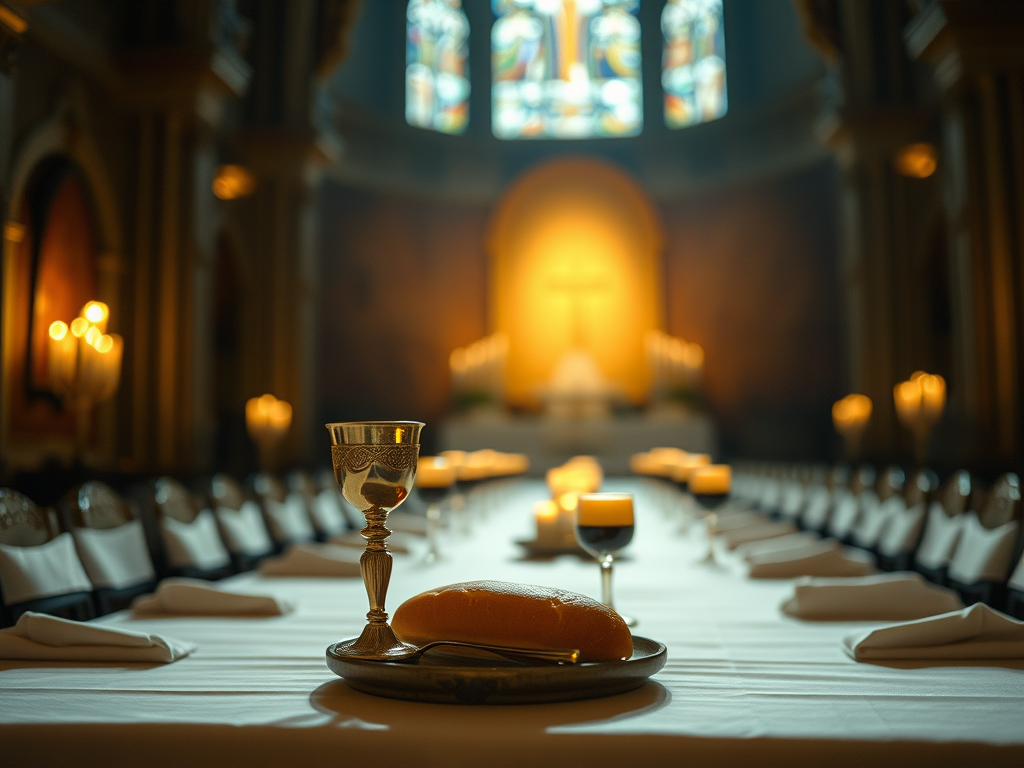
It probably goes without saying, but it is a rather rare occasion that I attend worship at a church that is not my own or not from my church body. Still, though I am Lutheran, I have observed Catholic mass many times, attended once as a Baptist congregation observing the Lord’s Supper, and twice at an Evangelical Church. The differences were significant.
While attending a large Evangelical church in my town, I listened as the pastor carefully explained how we are reverently remembering the death of Jesus and proclaiming our faith in Jesus’ sacrifice for us. I agreed with all that he said. At the particular Baptist church I attended, the pastor started by saying, “Now, this is not the body and blood of Christ.” I thought his statement was very misguided and kind of brassy considering Jesus introduced the Supper by saying the opposite. At the Masses, I would say that I could agree with every word that was said except for one sentence. The sentence, spoken by the people, asked God to accept the sacrifice offered by the priest.
The Lord’s Supper is a counter-cultural and complex thing. It does not come from the culture of Hebrews and certainly not from ours. It comes from the culture of God. The fact that it is so out of our league intellectually, has led many of us to fill in the blanks about what is going on incorrectly. Still, there is more information available in the Bible than most acknowledge. We struggle with the supernatural and counter-intuitiveness of it.
Let’s start with the most logical part of it. Is the Lord’s Supper a remembrance of Jesus’ sacrificial death for us? Absolutely. Jesus says that and it make sense, sort of. One has to admit that, though if the Lord’s Supper is only a way of remembering, then it is a very bizarre way to do so and very culturally offensive. To even symbolically eat somebody’s body and drink their blood is gross. I can think of scores of more effective and acceptable ways to remember.
Is the Lord’s Supper some sort of ongoing sacrifice of Christ? The logic is that sacrifices were made for centuries before Jesus, perhaps now the true sacrifice of Jesus continues on in this fashion. I can see the logic, but I would need a statement using the language of sacrifice to affirm it; instead, I find the opposite:
25 Nor was it to offer himself repeatedly, as the high priest enters the holy places every year with blood not his own, 26 for then he would have had to suffer repeatedly since the foundation of the world. But as it is, he has appeared once for all at the end of the ages to put away sin by the sacrifice of himself.
Hebrews 9:25-26 (ESV)
One time seems to get the job done. So then, what are we doing? I believe Jesus should be taken literally when He tells His disciples this is my body and this is my blood. The objections to this seem to circle around the questions, “How?” and “Why?”
In a prior career I was an engineer. In college I was obliged to take Physics. One the laws of physics is the Conservation of Mass. Handing out Jesus’ literal body and blood would seem to deplete the source many times over. But keep in mind what Jesus did with a few loaves of bread and fish. He fed 5000 men plus I assume women and children and finished with more scraps than the mass He started with! God isn’t particularly constrained by the laws of physics.
On that topic, when I receive the bread and wine of the Supper, I taste bread and wine. For this I am grateful. Some have said that the delivery is “spiritual”. But by “spiritual” they meant “intellectual”. We are back to remembering in a weird way. I think less a tainted term than spiritual would be “supernaturally” or “mystically”. The fact is that we don’t know how it is there, just that it is. It could an extra-dimensional thing. Who knows?
The more exciting question is “Why?” To get to the answer we need to back up a bit.
We are saved by Jesus fulfilling God’s Law on our behalf. He also absorbs the spiritual death we have earned with our sins by being forsaken on the cross. How is the work of Jesus applied to us personally, because not everyone is saved? Is it just God’s bookkeeping? We hear the promise, believe the promise, and God writes our name in the Book of Life? While I don’t doubt that this happens, the whole story is more complicated than that. God has to forge some sort of connection between us and Jesus. It is a type of connection that is very alien to our experience. We cannot sense it, but it impacts our lives greatly. The Bible speaks of this connection in terms like, “in Christ”, “in Him”, in some situations “faith”, and “the body of Christ.” Theologians have chosen a non-biblical term (similar to using the word “Trinity), the “mystical union”.
The Lord’s Supper is primarily for the sustenance of the mystical union. I will write more about this connection and how it relates to the Lord’s Supper in my next entry.

 Giving Christ